
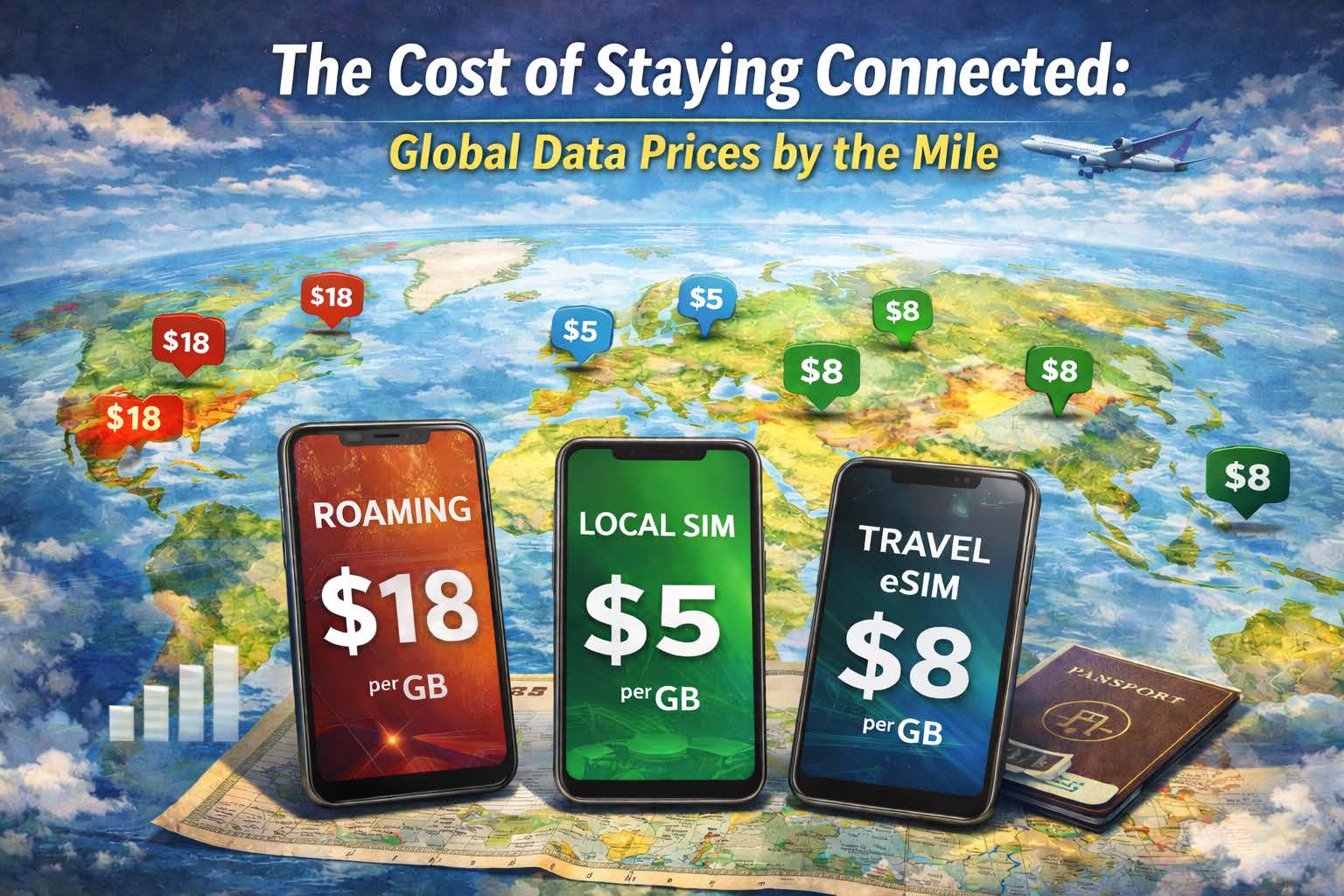
How roaming, local SIMs, and eSIMs compare when your journey crosses borders
There’s a moment every traveler knows. You land, switch your phone off airplane mode, and pause. Will this next tap cost pennies… or dollars?
Connectivity has become as essential as your passport. Maps, boarding passes, banking apps, rideshares, and work tools all depend on mobile data. But the real cost of staying online around the world can vary wildly. A quick check of email in one country might cost less than a coffee, while streaming a short video in another could quietly burn through a week’s budget.
Think of global data as a moving price tag that changes by the mile. As you travel from city to city and country to country, your cost per megabyte shifts like exchange rates. Understanding how roaming, local SIMs, and travel eSIMs compare can make the difference between smart planning and surprise charges.
Welcome to the economics of staying connected on the road.
Why Data Costs Change Across Borders
Unlike fuel prices posted on a highway sign, mobile data costs are hidden behind networks, agreements, and infrastructure. Each country has different carriers, competition levels, and regulations. Some places have fast, affordable connectivity everywhere. Others still treat mobile data as a premium resource.
When you travel, your phone must connect to a local network through one of three main paths:
-
International roaming through your home carrier
-
A local SIM purchased in-country
-
A travel eSIM with multi-country coverage
Each option carries its own pricing logic, convenience level, and hidden tradeoffs.
The Roaming Reality: Convenience at a Price
Roaming is the easiest path. You land, your phone connects, and everything works exactly as it did at home.
But simplicity often comes at the highest cost.
Traditional roaming plans are built on partnerships between carriers. Your home provider pays the local network for access and passes that cost along to you. In some cases, they add daily fees or per-megabyte rates that quickly stack up.
The result can feel like paying international shipping for every bit of data you use.
Roaming tends to make sense when:
-
You’re traveling for a very short time
-
You need instant connectivity for calls and texts
-
You don’t want to change anything on your device
But for longer trips or data-heavy usage, the math gets complicated quickly. A week of roaming can cost more than an entire month of prepaid data in many regions.
The Local SIM Strategy: Cheapest, But Not Always Easiest
Local SIM cards often offer the lowest cost per gigabyte. Once you’re connected to a domestic plan, you’re essentially paying what residents pay.
That’s the upside.
The downside is the process. Buying a local SIM means:
-
Finding a shop at the airport or in the city
-
Providing ID in some countries
-
Swapping out your primary SIM
-
Potentially losing access to your main phone number and not knowing your new number until you are in country and far away from your friends and family
For single-country trips, this can work well. If you’re staying in one place for weeks or months, local pricing is hard to beat.
But the moment your trip crosses a border, the advantage fades. That local SIM may not work in the next country. Suddenly you’re repeating the process again. New SIM, new plan, new setup.
What starts as a budget move can turn into a cycle of constant switching.
The Travel eSIM Middle Ground
Travel eSIMs emerged to bridge the gap between convenience and cost.
Instead of paying high roaming rates or juggling multiple physical SIM cards, you install a digital profile that connects to partner networks across multiple countries. When you move, the connection moves with you.
From a cost perspective, travel eSIMs often sit in the middle:
-
More affordable than roaming
-
Slightly higher per-GB than local SIMs
-
Far more flexible across borders
- With OneSimCard, you know your new phone number ahead of your trip and can give it to friends and family
For travelers who cross multiple countries in one trip, the overall value becomes clear. You avoid repeated purchases, save time, and keep a steady, predictable connection.
The Price Per Mile Concept
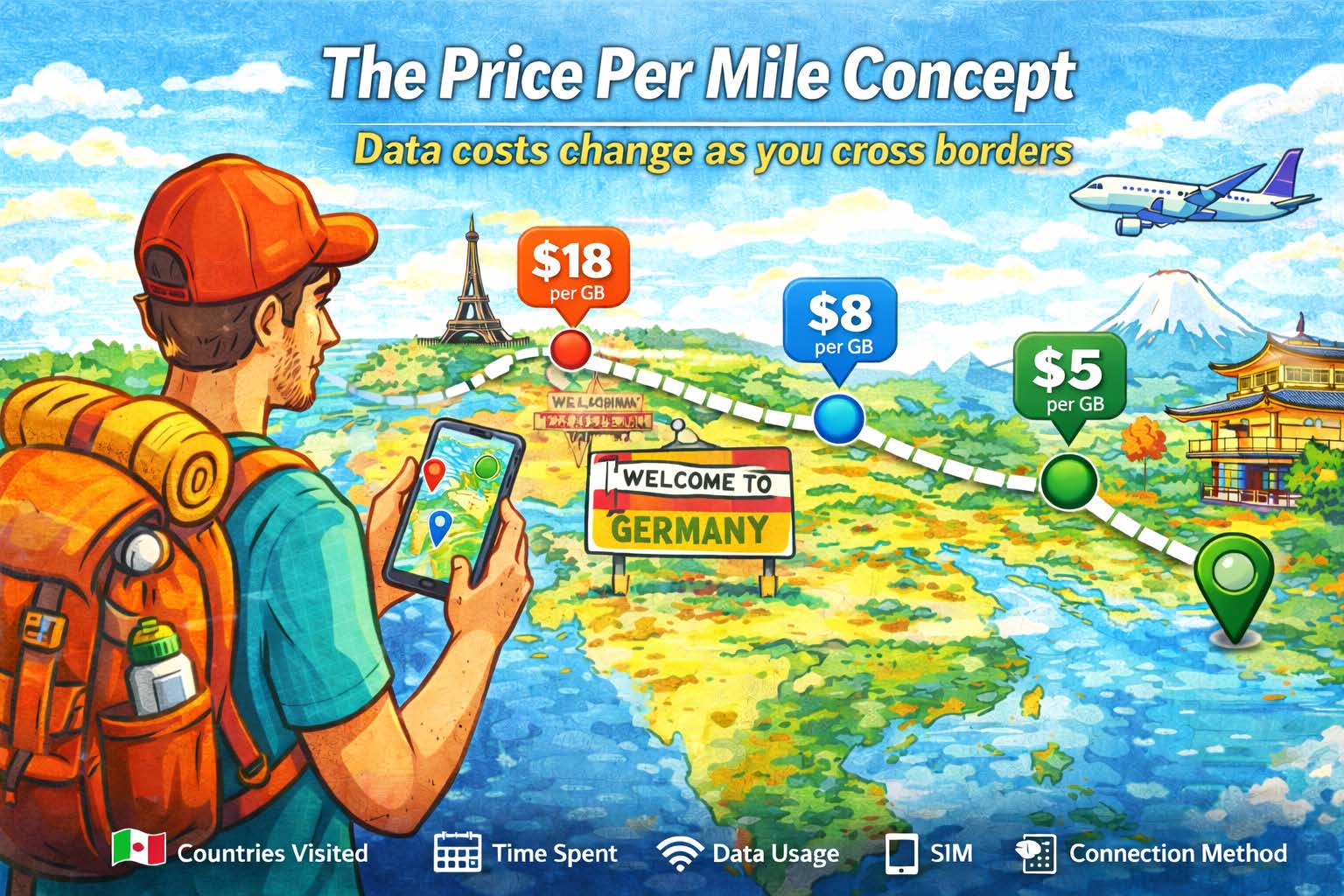
Imagine plotting data prices on a map the same way you track gas stations during a road trip.
In major cities with strong competition, mobile data tends to be cheaper. Dense infrastructure, multiple carriers, and high demand push prices down.
In remote regions or smaller markets, costs can rise. Limited infrastructure means fewer options and higher wholesale rates.
When traveling internationally, your effective “price per mile” depends on:
-
How many countries you visit
-
How long you stay in each place
-
How much data you use
-
Which connection method you choose
A single-country trip might favor a local SIM. A multi-country route often leans toward eSIM. A quick business trip might justify roaming for speed.
There’s no one-size-fits-all answer. There’s only the right choice for your journey.
The Hidden Costs Beyond Price
Data pricing isn’t just about dollars per gigabyte. There are other factors that shape the true cost of staying connected.
Time
Searching for SIM shops, waiting in line, and setting up new plans takes time you could spend exploring or working.
Continuity
Switching SIM cards can interrupt access to your primary number, banking alerts, or two-factor authentication.
Coverage
Some plans work well in cities but struggle in rural areas. Multi-network access can make a noticeable difference.
Stress
Unexpected charges, slow speeds, and connection gaps can turn small issues into big headaches.
When you consider these factors together, the “cheapest” option isn’t always the most economical in the long run.
How Digital Nomads Think About Connectivity Costs
For remote workers, data isn’t a luxury. It’s infrastructure.
A freelancer uploading files, a developer joining video calls, or a content creator sharing media depends on reliable, steady connectivity. The goal isn’t just low cost. It’s predictable performance.
This is where the value equation shifts.
Instead of asking, “What’s the cheapest gigabyte?” many nomads ask:
-
Will this work everywhere I go?
-
Will I stay connected across borders?
-
Can I avoid constant setup and downtime?
For long-term travel, consistency often matters more than squeezing out the lowest possible price in each location.
The Visual Map of Global Data Value
If you could see global data prices drawn across a world map, it might look like a patchwork quilt.
Some regions would glow with affordable, fast connectivity. Others would show higher prices or limited coverage. And across it all, you’d see three overlapping layers:
-
Roaming, with wide reach but higher costs
-
Local SIMs, with low prices but limited range
-
Travel eSIMs, offering balance across distance
The best choice depends on how your path crosses that map.
A single destination favors simplicity.
A long stay favors local integration.
A multi-country adventure favors flexibility.
Making the Smart Choice for Your Trip
Before your next journey, think about your data plan the way you think about your route.
Ask yourself:
-
Am I staying in one country or moving frequently?
-
Do I need constant access for work or navigation?
-
How important is keeping my main number active?
-
Do I want the lowest possible cost, or the most consistent experience?
These answers will guide you toward the best option for your situation.
Staying Connected Without Surprises
In the end, the true cost of connectivity isn’t just measured in gigabytes. It’s measured in freedom.
The freedom to open your map without hesitation.
To book a ride without searching for Wi-Fi.
To send a message from a train crossing a border.
When you understand how roaming, local SIMs, and travel eSIMs compare, you can choose a path that fits your travel style and your budget.
Because every mile you travel shouldn’t feel like a meter running in the background.
It should feel like the world getting a little more connected, one signal bar at a time.