
No Bars, No Panic: Travel Survival Stories Powered by eSIMs

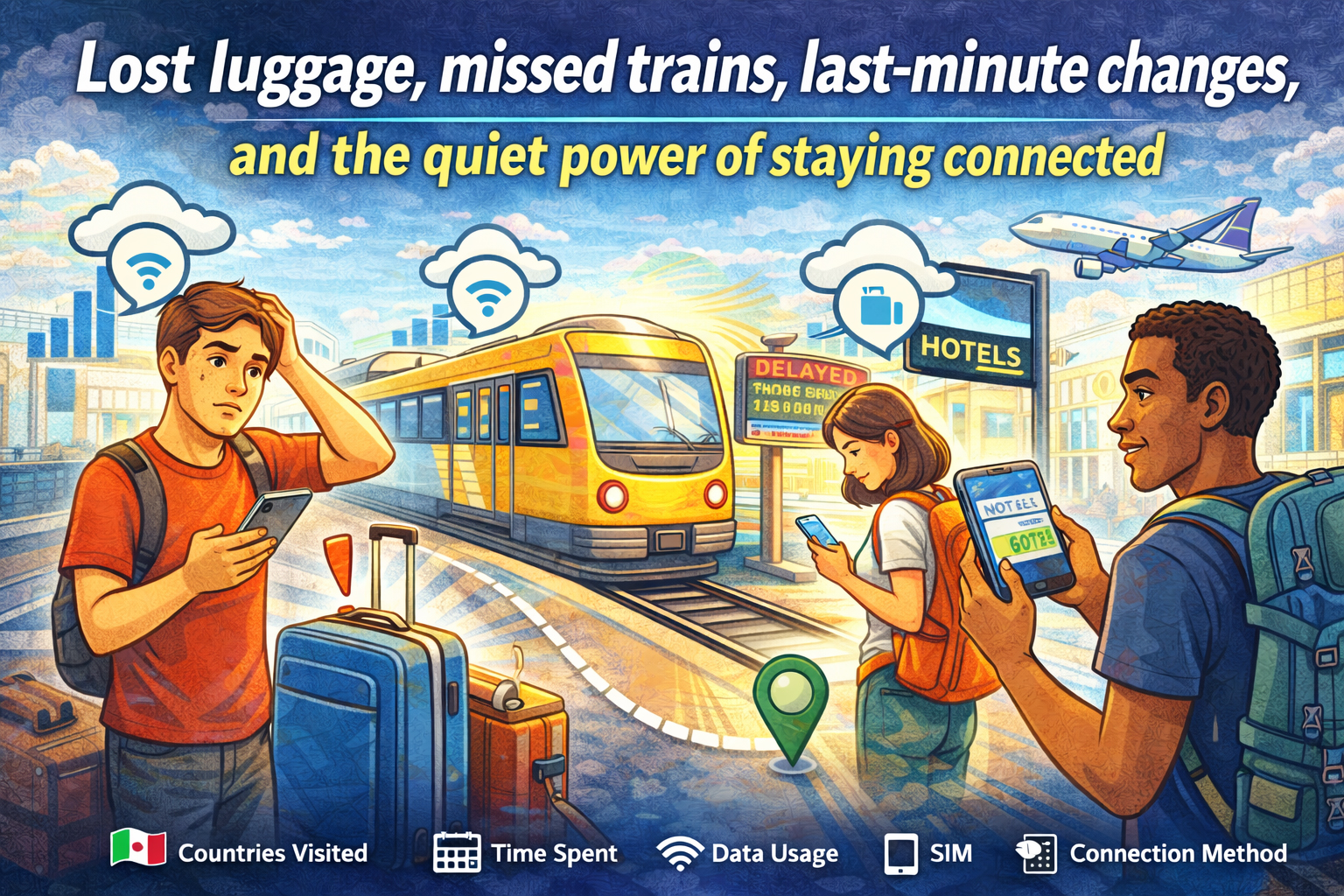
Lost luggage, missed trains, last-minute changes, and the quiet power of staying connected - travelers solving travel issues with eSIM

Lost luggage, missed trains, last-minute changes, and the quiet power of staying connected

Every traveler collects stories. Some are about beautiful views, incredible meals, and unexpected friendships. Others begin with a sinking feeling. A missed train. A lost bag. A canceled flight. A street sign you can’t read.

In those moments, the difference between stress and control often comes down to one simple thing: cellular signal.

There was a time when being overseas meant being temporarily unreachable. No maps, no ride apps, no instant help. Today, connectivity travels with you. And for many modern travelers, an eSIM has quietly become the difference between chaos and calm.

These are the kinds of real-world survival stories that play out every day. Not dramatic enough for headlines. But important enough to shape how a trip unfolds.

And in each one, a simple data connection turns panic into a plan.


The Missed Train That Didn’t Ruin the Trip

It happens fast. A late taxi. A long line for coffee. One wrong platform. Suddenly, the train you planned your day around is pulling away without you.

You’re in a country where you don’t speak the language, and the station boards flicker with destinations you don’t recognize.

In the past, this moment meant finding an information desk and hoping someone could help. Now, it’s a different kind of response.

Phone out. Data on.

Within minutes:

  • A new route is found on a maps app

  • A later train is booked online

  • A message goes out to the hotel about the delayed arrival

Instead of standing still, you’re moving again. A missed train becomes a detour instead of a disaster.

This is where an eSIM shines. Because your connection doesn’t depend on finding Wi-Fi in a crowded station. It’s already there, ready the moment plans change.


The Lost Luggage That Still Found Its Way Home

Standing at the baggage carousel while it spins and empties is a special kind of suspense. Everyone else leaves. The belt stops. Your bag is nowhere in sight.

Now what?

Without a connection, the process can feel slow and uncertain. But with reliable data, the next steps happen quickly.

Airline apps track the missing bag. Claim forms get filled out online. The hotel address gets sent directly to the airline. Notifications arrive when the bag is located and on its way.

You can even check nearby stores, order a few essentials, and get through the first night without your things.

Luggage gets lost. It’s part of travel. But staying connected means you’re never left guessing what happens next.


The Night Arrival in an Unfamiliar City

Landing in a new country after dark is always a little disorienting. The streets look different. The language sounds different. Even the signs feel unfamiliar.

Now imagine your hotel is across town, public transit is limited at night, and the taxi stand is crowded.

This is when a smartphone becomes your lifeline.

With data ready to go, you can:

  • Open a rideshare app and request a pickup

  • Double-check the hotel address

  • Share your location with someone back home

  • Translate directions if needed

Instead of wandering, you move with purpose. Instead of uncertainty, there’s a clear path from airport to door.

The difference is quiet but powerful. You don’t have to think about whether your phone will connect. It just does.


The Wrong Turn That Turned Into a Better Day

Some of the best travel memories begin with a wrong turn.

But in the moment, it doesn’t feel romantic. You’re in a neighborhood you don’t recognize. The street names don’t match your map. And you’re not sure which way leads back.

This is where instant access to navigation makes all the difference.

With mobile data:

  • You reorient in seconds

  • You find the nearest transit stop

  • You discover a café or landmark you never planned to see

Getting lost stops being stressful and starts becoming part of the experience.

A strong connection doesn’t just help you get un-lost. It helps you explore with confidence.


The Last-Minute Hotel Change

Flights get delayed. Connections get missed. Sometimes the hotel you planned to reach just isn’t reachable anymore.

Instead of arriving exhausted and searching for help, travelers with a steady connection can solve the problem on the spot.

Book a nearby room.
Check reviews.
Confirm availability.
Get directions instantly.

In the space of a few minutes, the night is back on track.

Without signal, this becomes a much longer, more complicated process. With signal, it’s just another quick adjustment.


The Emergency Call Home

Not every travel story is about inconvenience. Sometimes, things get serious.

A sudden illness. A stolen wallet. A situation where you need to reach someone quickly.

In those moments, being connected matters in a deeper way.

You can:

  • Call home through an app like OneSim VoIP

  • Contact your bank immediately

  • Find the nearest clinic or pharmacy

  • Access translation tools to explain what’s happening

It’s not just about data. It’s about reassurance. The ability to reach help, to explain, to solve problems as they happen.

And often, that connection starts the moment your plane lands, thanks to a travel eSIM already installed and ready to work. And with OneSim VoIP you can access SMS and voice. The best thing about OneSim VoIP is that, unlike other VoIP Apps, both sides don’t need to have the app, you can even call landlines!


The Work Emergency Abroad

For digital nomads and business travelers, the stakes can be even higher.

An urgent email arrives. A client needs a file. A meeting time changes.

When work travels with you, connectivity isn’t optional.

With reliable mobile data, you can:

  • Join a video call from a taxi

  • Send files from a train platform

  • Respond to urgent messages without searching for Wi-Fi

The trip continues, but your responsibilities stay in motion too.

And because an eSIM keeps you connected across countries, you don’t have to think about whether your data will work at the next stop.


The Confidence Factor

All of these moments have one thing in common.

They start with uncertainty. And they end with a solution powered by connection.

That’s the real value of staying connected while traveling. Not just the convenience, but the confidence.

Confidence to try new places.
Confidence to change plans.
Confidence to handle the unexpected.

Because you know that if something goes wrong, your phone is more than a camera. It’s your map, your translator, your booking desk, your safety net.


From “No Bars” to No Panic

The phrase “no bars” used to mean isolation. Silence. Waiting.

Today, the goal is simple: avoid that moment altogether.

A travel eSIM helps make that possible by giving you:

  • Instant connectivity when you land

  • Coverage across multiple countries

  • No need to swap physical SIM cards

  • Reliable access to data when you need it most

It doesn’t make problems disappear. But it makes them manageable.

And that’s the difference between panic and problem-solving.


Travel Will Always Be Unpredictable

That’s part of the magic.

Trains run late. Bags get lost. Plans change. Streets twist. Weather shifts.

But modern travel comes with tools that help you adapt as quickly as the world changes around you.

The ability to pull out your phone and find a solution in seconds can turn the worst moments into stories you laugh about later.

Stories that begin with a problem.
And end with a signal.

Because sometimes, survival on the road doesn’t come from planning every detail.

It comes from knowing that wherever you are, you’re still connected.
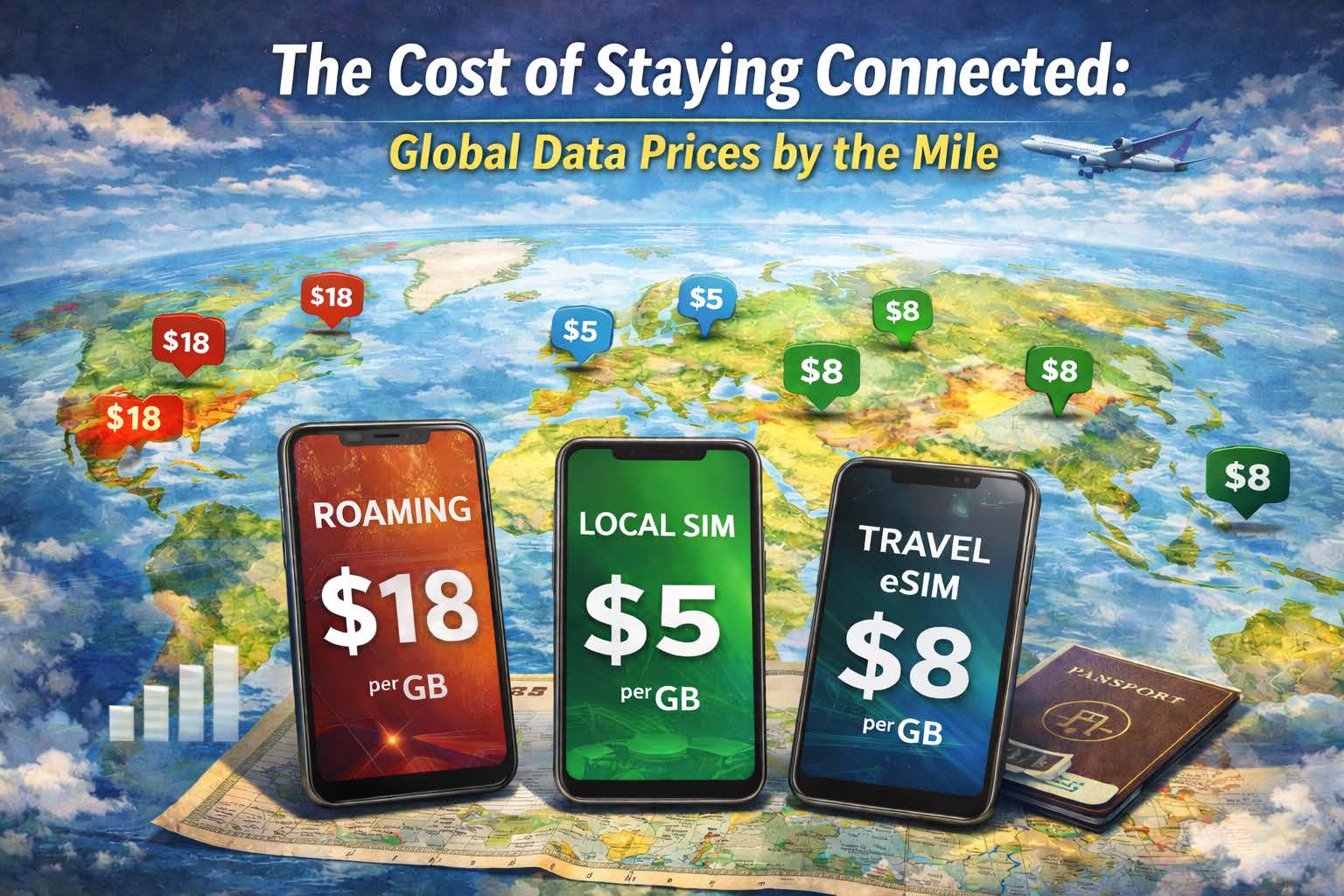
The Cost of Staying Connected: Global Data Prices by the Mile

Global map showing the difference in costs of SIM card types

How roaming, local SIMs, and eSIMs compare when your journey crosses borders

There’s a moment every traveler knows. You land, switch your phone off airplane mode, and pause. Will this next tap cost pennies… or dollars?

Connectivity has become as essential as your passport. Maps, boarding passes, banking apps, rideshares, and work tools all depend on mobile data. But the real cost of staying online around the world can vary wildly. A quick check of email in one country might cost less than a coffee, while streaming a short video in another could quietly burn through a week’s budget.

Think of global data as a moving price tag that changes by the mile. As you travel from city to city and country to country, your cost per megabyte shifts like exchange rates. Understanding how roaming, local SIMs, and travel eSIMs compare can make the difference between smart planning and surprise charges.

Welcome to the economics of staying connected on the road.


Why Data Costs Change Across Borders

Unlike fuel prices posted on a highway sign, mobile data costs are hidden behind networks, agreements, and infrastructure. Each country has different carriers, competition levels, and regulations. Some places have fast, affordable connectivity everywhere. Others still treat mobile data as a premium resource.

When you travel, your phone must connect to a local network through one of three main paths:

  1. International roaming through your home carrier

  2. A local SIM purchased in-country

  3. A travel eSIM with multi-country coverage

Each option carries its own pricing logic, convenience level, and hidden tradeoffs.


The Roaming Reality: Convenience at a Price

Roaming is the easiest path. You land, your phone connects, and everything works exactly as it did at home.

But simplicity often comes at the highest cost.

Traditional roaming plans are built on partnerships between carriers. Your home provider pays the local network for access and passes that cost along to you. In some cases, they add daily fees or per-megabyte rates that quickly stack up.

The result can feel like paying international shipping for every bit of data you use.

Roaming tends to make sense when:

  • You’re traveling for a very short time

  • You need instant connectivity for calls and texts

  • You don’t want to change anything on your device

But for longer trips or data-heavy usage, the math gets complicated quickly. A week of roaming can cost more than an entire month of prepaid data in many regions.


The Local SIM Strategy: Cheapest, But Not Always Easiest

Local SIM cards often offer the lowest cost per gigabyte. Once you’re connected to a domestic plan, you’re essentially paying what residents pay.

That’s the upside.

The downside is the process. Buying a local SIM means:

  • Finding a shop at the airport or in the city

  • Providing ID in some countries

  • Swapping out your primary SIM

  • Potentially losing access to your main phone number and not knowing your new number until you are in country and far away from your friends and family

For single-country trips, this can work well. If you’re staying in one place for weeks or months, local pricing is hard to beat.

But the moment your trip crosses a border, the advantage fades. That local SIM may not work in the next country. Suddenly you’re repeating the process again. New SIM, new plan, new setup.

What starts as a budget move can turn into a cycle of constant switching.


The Travel eSIM Middle Ground

Travel eSIMs emerged to bridge the gap between convenience and cost.

Instead of paying high roaming rates or juggling multiple physical SIM cards, you install a digital profile that connects to partner networks across multiple countries. When you move, the connection moves with you.

From a cost perspective, travel eSIMs often sit in the middle:

  • More affordable than roaming

  • Slightly higher per-GB than local SIMs

  • Far more flexible across borders

  • With OneSimCard, you know your new phone number ahead of your trip and can give it to friends and family

For travelers who cross multiple countries in one trip, the overall value becomes clear. You avoid repeated purchases, save time, and keep a steady, predictable connection.


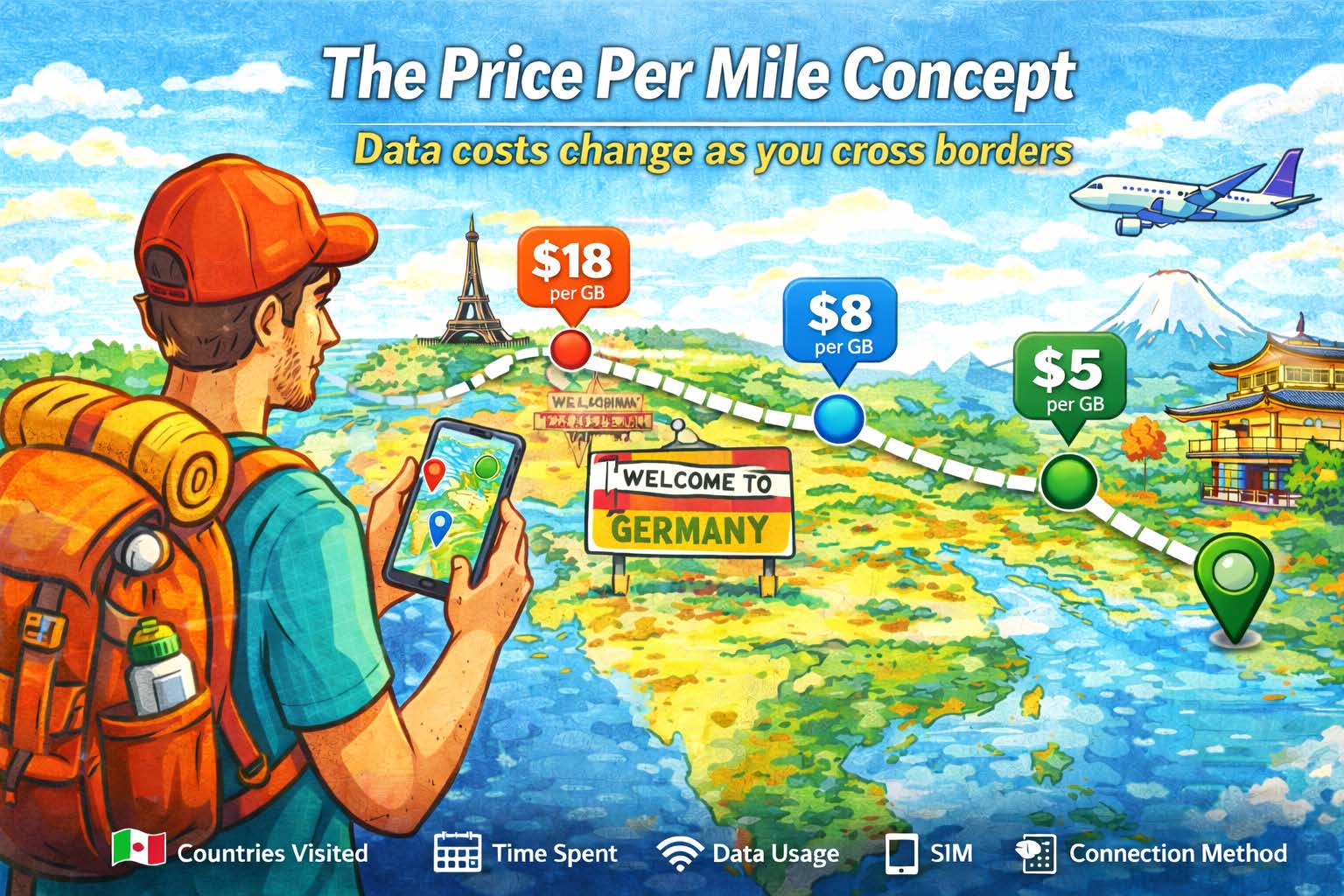
The Price Per Mile Concept

Cost per mile of international connectivity

Imagine plotting data prices on a map the same way you track gas stations during a road trip.

In major cities with strong competition, mobile data tends to be cheaper. Dense infrastructure, multiple carriers, and high demand push prices down.

In remote regions or smaller markets, costs can rise. Limited infrastructure means fewer options and higher wholesale rates.

When traveling internationally, your effective “price per mile” depends on:

  • How many countries you visit

  • How long you stay in each place

  • How much data you use

  • Which connection method you choose

A single-country trip might favor a local SIM. A multi-country route often leans toward eSIM. A quick business trip might justify roaming for speed.

There’s no one-size-fits-all answer. There’s only the right choice for your journey.


The Hidden Costs Beyond Price

Data pricing isn’t just about dollars per gigabyte. There are other factors that shape the true cost of staying connected.

Time

Searching for SIM shops, waiting in line, and setting up new plans takes time you could spend exploring or working.

Continuity

Switching SIM cards can interrupt access to your primary number, banking alerts, or two-factor authentication.

Coverage

Some plans work well in cities but struggle in rural areas. Multi-network access can make a noticeable difference.

Stress

Unexpected charges, slow speeds, and connection gaps can turn small issues into big headaches.

When you consider these factors together, the “cheapest” option isn’t always the most economical in the long run.


How Digital Nomads Think About Connectivity Costs

For remote workers, data isn’t a luxury. It’s infrastructure.

A freelancer uploading files, a developer joining video calls, or a content creator sharing media depends on reliable, steady connectivity. The goal isn’t just low cost. It’s predictable performance.

This is where the value equation shifts.

Instead of asking, “What’s the cheapest gigabyte?” many nomads ask:

  • Will this work everywhere I go?

  • Will I stay connected across borders?

  • Can I avoid constant setup and downtime?

For long-term travel, consistency often matters more than squeezing out the lowest possible price in each location.


The Visual Map of Global Data Value

If you could see global data prices drawn across a world map, it might look like a patchwork quilt.

Some regions would glow with affordable, fast connectivity. Others would show higher prices or limited coverage. And across it all, you’d see three overlapping layers:

  • Roaming, with wide reach but higher costs

  • Local SIMs, with low prices but limited range

  • Travel eSIMs, offering balance across distance

The best choice depends on how your path crosses that map.

A single destination favors simplicity.
A long stay favors local integration.
A multi-country adventure favors flexibility.


Making the Smart Choice for Your Trip

Before your next journey, think about your data plan the way you think about your route.

Ask yourself:

  • Am I staying in one country or moving frequently?

  • Do I need constant access for work or navigation?

  • How important is keeping my main number active?

  • Do I want the lowest possible cost, or the most consistent experience?

These answers will guide you toward the best option for your situation.


Staying Connected Without Surprises

In the end, the true cost of connectivity isn’t just measured in gigabytes. It’s measured in freedom.

The freedom to open your map without hesitation.
To book a ride without searching for Wi-Fi.
To send a message from a train crossing a border.

When you understand how roaming, local SIMs, and travel eSIMs compare, you can choose a path that fits your travel style and your budget.

Because every mile you travel shouldn’t feel like a meter running in the background.

It should feel like the world getting a little more connected, one signal bar at a time.

Discover the Majesty of Switzerland & Share with Your Switzerland SIM Card

Lauterbrunnen Alps
Lauterbrunnen Valley and Alps

Switzerland is known worldwide as one of the most beautiful places on earth. It is no wonder why with the towering Alps, lush green valleys, sapphire blue lakes, and varied cultures. Switzerland is an international destination for people with varied interests.

Introduction

Switzerland is also (and officially) known as the Swiss Confederation. It is made up of 26 Cantons, with Federal offices located in Bern. The population of Switzerland is ~8.2 million, with ~1/4 of the population being expats from other (mostly European) countries. This makes Switzerland the country with the most foreign population.

The climate of Switzerland is as varied as its population. There are three main geographies of Switzerland. The Alps, the Swiss Plateau, and the Jura mountains. Most of the population reside on the Plateau where all of the major cities are located. The climate is temperate, but ranges wildly depending on the locality. You will find year-round snow and glaciers in the mountains, but also palm trees in the southern plateau.

Regions

The Alps

The Alps are among the highest and most rugged mountains in the world. The highest peak is Dufourspitze. It is the second highest in Western Europe at 4,736m and is a challenge for any climber. They were formed by the collision of the African and European plates, and continue to grow.

Besides climbing, the Alps are home to a myriad of winter sports like skiing (alpine and cross-country), sledding, snowboarding, and summer sports like para-gliding and skydiving.  For the less active, the valleys in the Alps offer absolutely stunning vistas and easy hikes. One of the favorites is the Lauterbrunnen valley. Lauterbrunnen is home to the highest railroad in Europe (Jungfrau Railway), taking you to the peak of Jungfraujoch at 3,454m.

The Plateau

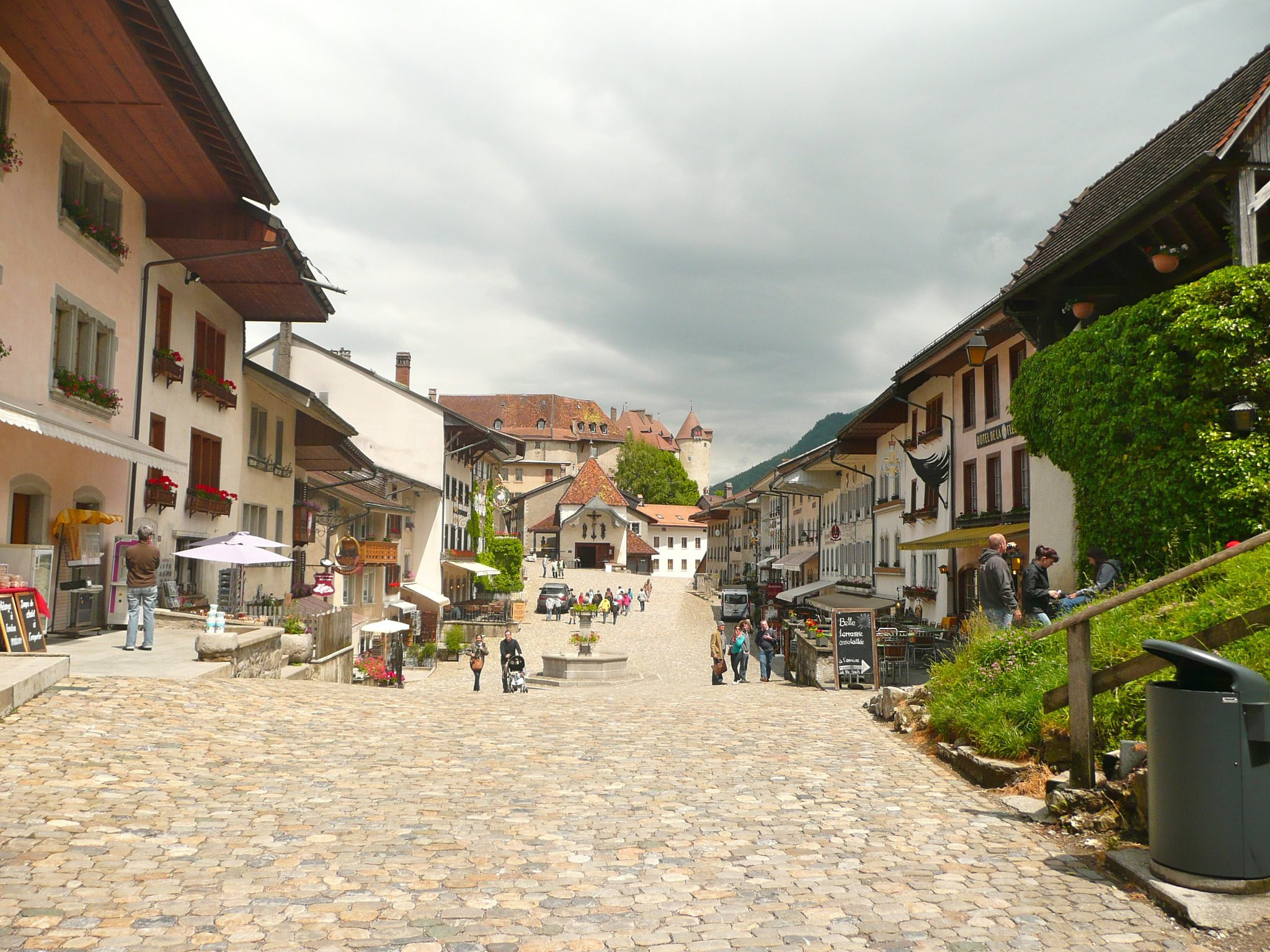
The Plateau is where you will find all of the major cities and beautiful lakes. With Zurich and Basel in the north, Bern centrally located and Geneva in the South, the Plateau is a collection of rolling hills, lakes, rivers and culinary delights like cheese and chocolate. (We recommend a trip to the picturesque town of Gruyere where the cheese is king and the views are stunning. kick back and enjoy some fondue!)

Gruyere
The cobblestone streets of Gruyere


Lake Geneva is easily the most famous of the large lakes, but Lakes Zurich, Lucerne, and the twin lakes of Brienz & Thun are all equally beautiful. If you visit the twin lakes, stay in Interlaken and you will have easy access to both lakes! You can enjoy swimming, boating and hikes around the lakes.

The Jura

The Jura mountains aren’t as famous as the Alps, but that doesn’t mean they aren’t worth visiting. It is the demarcation between France and Switzerland. The Jura aren’t as tall and rugged as the Alps, but there is still lots of great opportunities for hiking, climbing, skiing, and cycling. This region is also known for its watchmaking industry. You can even be an “Apprentice for a day” and build your own watch!

The people of Switzerland are as varied as its geography. The landlocked country boarders France, Italy, Germany, Austria and Liechtenstien. This mixing of cultures creates a diversity in language as well as food, Local dishes are pulled from all of these countries and tend to align country to which that canton is closest. For example, one of our favorite lasagnas was enjoyed in the south, closer to Italy, while in Zurich we had fantastic bratwurst closer to Germany. This melding of cultures also shows in languages spoken, and traditional dress.

Getting Around

When travelling to Switzerland from international origina you will typically Fly into Geneva or Zurich. You may also find flights into Bern, but this is smaller international airport, and is typically used on a regional basis. Once you are in country, the train system is a fantastic way to get around. The trains run remarkably on schedule and are always clean and modern. You will find that the local trains are also used by schools to transport their students, so don’t be surprised to share the ride with lots of kids.

Speaking of trains, we recommend the GoldenPass Line for sightseeing. The GoldenPass trains are designed with huge windows  so you won’t miss a bit of scenery. There are 3 main lines: 1) Montreaux > Zweissimmen, 2) Zweissimmen > Interlaken Ost, & 3) Interlaken Ost > Lucerne. You can break up the trips stopping for a night or two in certain areas (we highly recommend the Lauterbrunnen Valley) and enjoy what these localities have to offer. You can also join an organized tour who will handle all of the bookings and activities along the way.

Summary

Switzerland is a truly majestic country with varied geography and cultures. There are many, many activities to enjoy year-round for people of all ages and physical abilities. We recommend travelling in June or July for the best weather. So grab your passport, pack your binoculars to make sure to see all of the stunning vistas and don’t forget your OneSimCard eSIM World or standard global roaming SIM card (the Switzerland SIM card we recommend is the Universal card) because you will want to stay connected to share all of your memories!

Enjoy 4G data in the United States and 35 other countries for less than a cent per MB!

OneSimCard Universal now offers a 10,000 MB (approx. 10GB) Data Plan valid for 30 days for only $86.90. This is less than a penny per MB in the United States!

At this price, it may sound like your local mobile provider’s type of offer. But there is a key difference. Your domestic data plan may have data throttling, 2G downgrades or other speed restrictions. OneSimCard has none of that.

OneSimCard’s plan simply comes with more 4G in more countries.

Since the 10,000MB plan is part of the Giga Data Zone, the coverage spans 36 countries. It includes Austria, Belgium, Bulgaria, Croatia, Cyprus, Czech Republic, Denmark, Estonia, Finland, France, Germany, Gibraltar, Greece, Hungary, Iceland, Ireland, Israel, Italy, Latvia, Liechtenstein, Lithuania, Luxembourg, Malta, Netherlands, Norway, Poland, Portugal, Romania, Russia, Slovakia, Slovenia, Spain, Sweden, Switzerland, USA and United Kingdom

That’s right. You can continue using the same blazing fast 4G data plan while traveling in the US, UK, most of Europe and even Russia. Compare that to your domestic carrier’s offer!

You can save even more money by pairing this plan with the OneSim Voip smartphone app. The OneSim VoiP app allows calling and texting over the internet for as little as 1c/min and 5c/message respectively.

The choice is clear. Enjoy faster 4G data in more places and for less money with OneSimCard.

The 10,000 MB data plan can be added to any OneSimCard Universal or OneSimCard Plus at any time from your OneSimCard web account.