
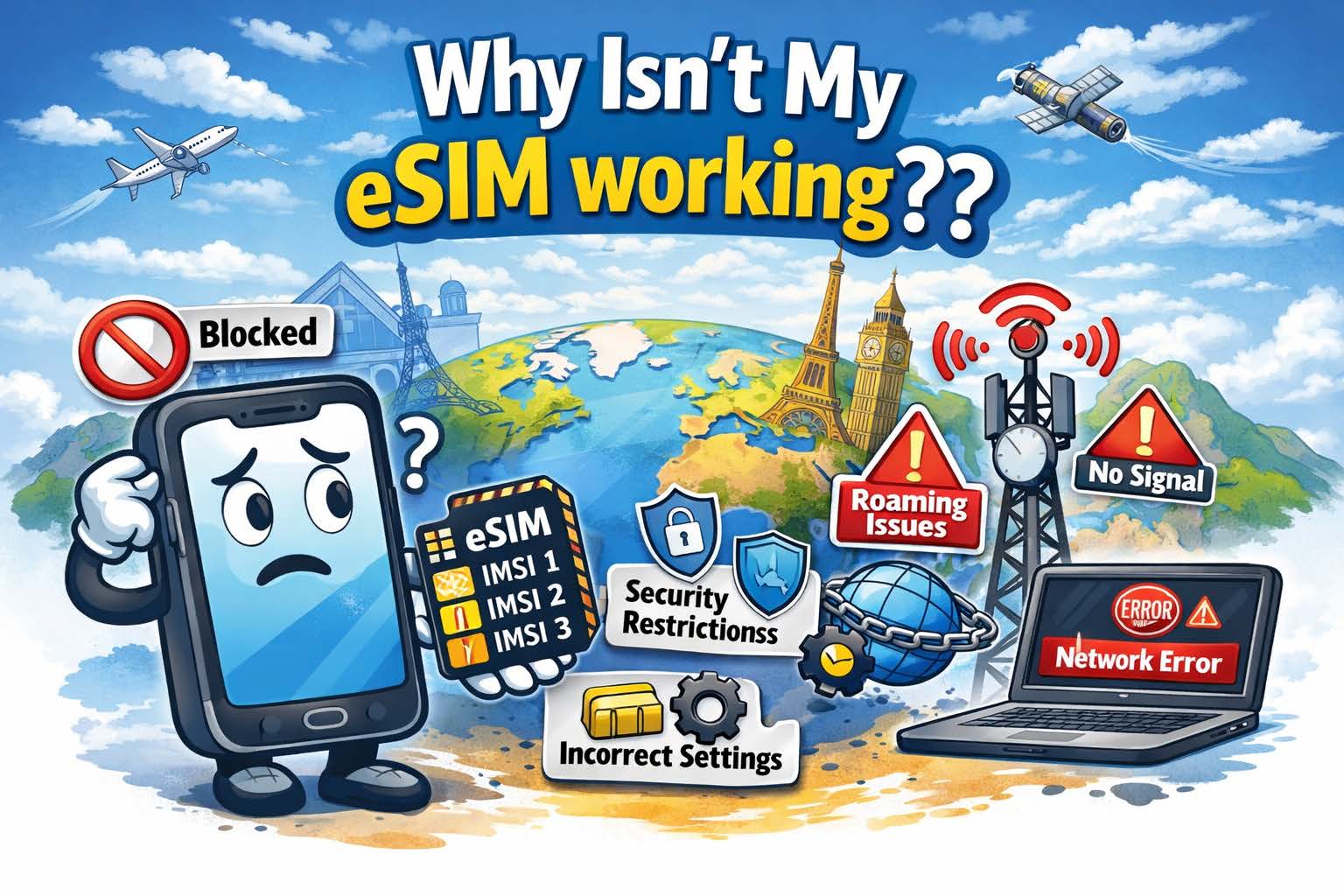
Why Isn’t My eSIM Working??

Why doesn't my eSIM work? There are several reasons
eSIMs and SIMs may not work for several reasons, but these issues are often simple to fix

Introduction

You installed your bright, shiny, new SIM Card or eSIM but, ut oh, it isn’t working!! WHY!!?? What is wrong with my eSIM? As a leading provider of both physical plastic SIM cards and eSIMs for international travel for over 30 years, we get this question a lot. There are a variety of reasons why SIM Cards or eSIMs don’t work in your mobile device when traveling internationally. We will discuss some of the most popular reasons, and, more importantly, the fixes for these problems. Let’s take these step-by-step the same way we do it when a customer contacts us with this problem.

SIM Locked Device

Probably the most popular problem is a very straightforward one, and you won’t even be able to install the SIM card or eSIM if this is the issue. The mobile device is carrier locked and you cannot use another SIM in the device. The easiest way to fix this is to contact your carrier and ask them to unlock the phone (or tablet, etc.). Even if you already paid off the device and there is no contract, you might need to proactively contact the carrier to get them to unlock the device. You will want to do this prior to travel, because you may need to be in the same country that your carrier is from. 32% of the time, this is the issue.

You Don’t Have the Correct Plan or Sufficient Balance on the SIM or eSIM

25% of the Support tickets we receive for a SIM or eSIM not working turns out to be the customer either didn’t buy the proper package for the country they are in, or they don’t have enough balance on the SIM or eSIM to use per-MB data. This is probably the easiest thing to fix, simply add funds to the SIM or purchase a package that allows usage in the country in which you are currently located.

International Roaming Isn’t Enabled

We are only human and some of the obvious things often slip past us! Yes, this is a very common mistake and when you realize this oversight, you will slap your forehead in embarrassment! Even if you aren’t tech savvy, this is a simple fix and we have created how-to videos to enable Data Roaming on both iOS and Android devices. This is a 1 minute fix and may solve your connectivity issue on your device. 17% of the time, this is the problem.

APN is Incorrect

First, what is an APN anyways!? The Telecom industry loves acronyms! APN stands for “Access Point Name.” It, quite literally, is the access point in which the device will run data through to the internet. Think of it as a “doorway to the internet.” Most times, the device will load the correct APN for the SIM card or eSIM you are using, but sometimes your device may not and you need to set it up manually. Don’t fret, just like enabling international roaming, this is an easy fix and only takes a minute.  Here are step-by-step instructions for setting the APN for:

iPhone

Android

IMPORTANT NOTE: The APN discussed in these videos are for our DataMax eSIM card. If you are using a different provider, contact them to get the correct APN for their SIM or eSIM. Having the wrong APN on your device is the problem of no data connectivity 12% of the time.

There Isn’t Any Coverage Where You Are

Believe it or not, this is an issue that does come up. Cellular network providers can’t cover every corner of the world, and they do a cost analysis to determine where and where not to cover. No bars, no data! About 8% of the support tickets we answer turn out that the user is in a very rural area that has no cellular service. Even with our multi-IMSI, multi-carrier SIMs or eSIMs have coverage gaps. Unfortunately, the only way to fix this issue is to move to a place where you can get those coveted bars of service.

Important Note: Not all providers are created equal when it comes to what operators they use in a particular country and how they prioritize the networks they use. This prioritization is done through a PRL (or Preferred Roaming List). They prioritize (or what we call “steer”) traffic to cheaper networks to save money. One possible result of this network steering is that you are forced onto a network with very little service, so data is slow or non-functional. OneSimCard is proud to NEVER steer traffic this way. We allow the device to choose the best available network  for that geographic area. This results in the best possible service for our customers.

Why OneSimCard eSIM Works Better for Travelers

Some eSIM issues come from weak network selection, limited coverage, or poor travel setup design. OneSimCard DataMax eSIM is built to reduce those headaches with global coverage, multiple networks in many destinations, and a more travel-friendly activation experience.

200+ Countries

Stay connected in a wide range of destinations without juggling multiple local SIM cards.

Multiple Networks

Better local network options can help improve reliability when one carrier underperforms.

Fast Activation

Get your eSIM by QR code and install it before you travel, so you land connected instead of hunting for fixes at the airport.

Your Device Isn’t “Rotating the IMSI”

What is an IMSI?? We know, more “jargon!” IMSI stands for “International Mobile Subscriber Identity.” Every SIM card or eSIM has one or multiple IMSI’s installed in the SIM card or eSIM software. The IMSI identifies the subscriber on a mobile network, and it is critical for roaming because it authenticates and manages the subscriber to provide proper routing for data, SMS, etc. There is a scheme to the unique 15 digit IMSI number, but for the purposes of this article, we won’t define that scheme.

Suffice to say, every mobile network operator issues this number to each of their subscribers, and every number is completely unique. The first part of the IMSI identifies who the IMSI belongs to. If an eSIM has multiple IMSI’s installed, the SIM or eSIM is using multiple mobile network operators’ roaming agreements to connect.

Companies like OneSimCard use Multi-IMSI SIMs or eSIMs to get the best price for our customers in a particular country. For example, one of our network partners might offer $0.15/MB in a particular country, where another partner offers $0.10/MB in a particular country. We use the less expensive partner in that country to keep your costs down. To properly find the right IMSI to use in a particular country, the device needs to rotate through the different IMSI’s until it finds the right one.

Some devices, however, don’t “like” Multi-IMSI SIMs and eSIMs because they are incapable of rotating the IMSI. In this case, we guide customers to manually choose the correct IMSI. This happens in 6% of our Support tickets. This may sound difficult, but, like the previous troubleshooting steps above, this is very simple. To manually choose the correct IMSI on a multi-IMSI SIM or eSIM, follow these steps:

  1. Contact your SIM provider and ask what the correct IMSI (partner operator) is for the country you are in.
  2. When you install an eSIM or SIM, there will be a new app installed on your device called “SIM Services.” Open this app.
  3. There will be a choice called “Multi IMSI” Click on this.
  4. On the next screen, click on “Select Mode”
  5. On the next screen, click on “Manual”
  6. On the next screen, there will be several choices. Each one of these choices is a different mobile network operator. Click on the one your operator told you to choose
  7. The app will then go back to the first screen, and you can then exit that app.

Important Note:  You changed the IMSI selection to Manual, if you change countries, the correct IMSI to use may change. You will need to follow the steps above to change the IMSI to the correct one.


Still Having eSIM Trouble?

Skip the connection roulette wheel. Choose a travel eSIM designed for real international use, with wide coverage, multiple networks, and fast setup.


Shop DataMax eSIM


Learn More About eSIM


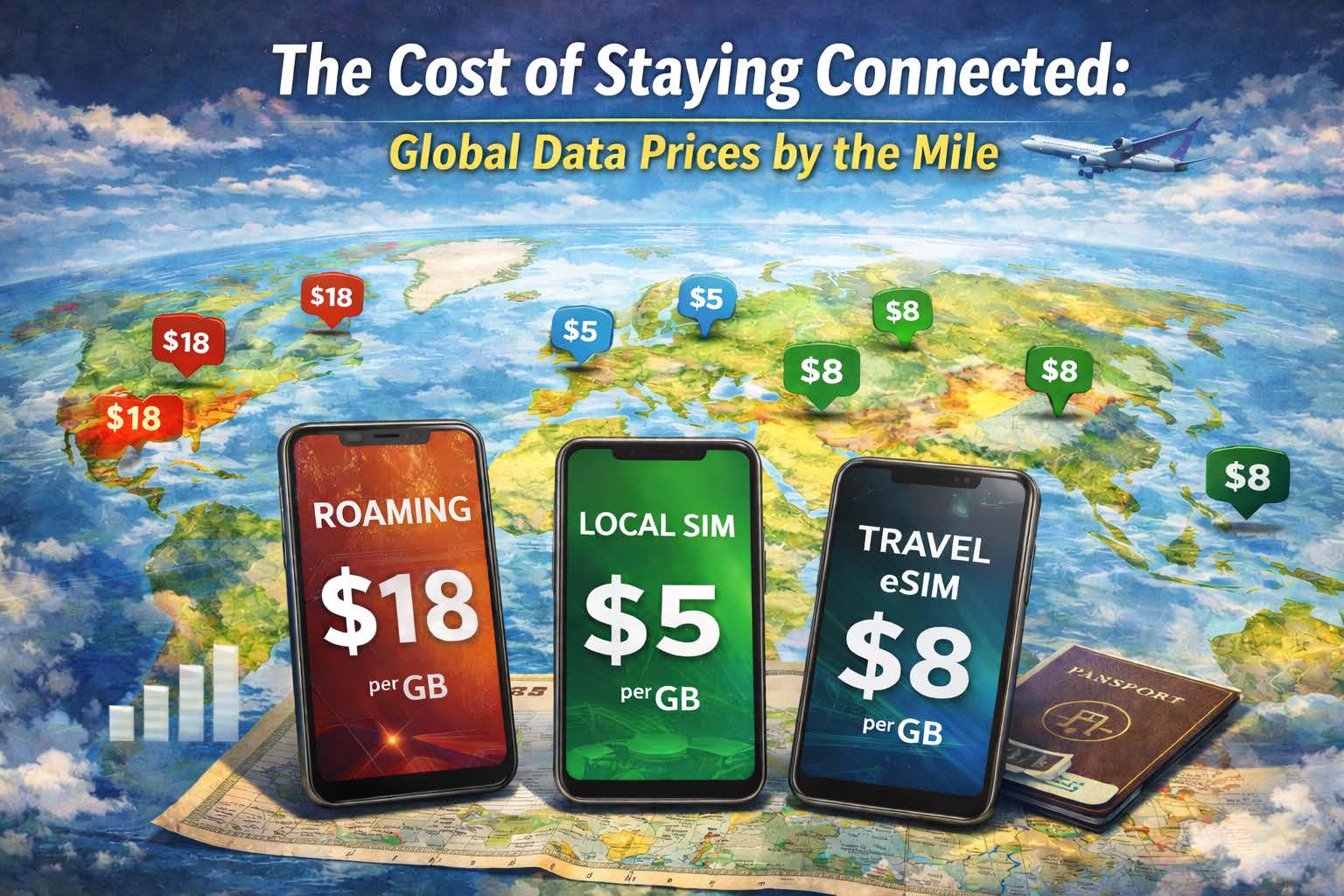
The Cost of Staying Connected: Global Data Prices by the Mile

Global map showing the difference in costs of SIM card types

How roaming, local SIMs, and eSIMs compare when your journey crosses borders

There’s a moment every traveler knows. You land, switch your phone off airplane mode, and pause. Will this next tap cost pennies… or dollars?

Connectivity has become as essential as your passport. Maps, boarding passes, banking apps, rideshares, and work tools all depend on mobile data. But the real cost of staying online around the world can vary wildly. A quick check of email in one country might cost less than a coffee, while streaming a short video in another could quietly burn through a week’s budget.

Think of global data as a moving price tag that changes by the mile. As you travel from city to city and country to country, your cost per megabyte shifts like exchange rates. Understanding how roaming, local SIMs, and travel eSIMs compare can make the difference between smart planning and surprise charges.

Welcome to the economics of staying connected on the road.


Why Data Costs Change Across Borders

Unlike fuel prices posted on a highway sign, mobile data costs are hidden behind networks, agreements, and infrastructure. Each country has different carriers, competition levels, and regulations. Some places have fast, affordable connectivity everywhere. Others still treat mobile data as a premium resource.

When you travel, your phone must connect to a local network through one of three main paths:

  1. International roaming through your home carrier

  2. A local SIM purchased in-country

  3. A travel eSIM with multi-country coverage

Each option carries its own pricing logic, convenience level, and hidden tradeoffs.


The Roaming Reality: Convenience at a Price

Roaming is the easiest path. You land, your phone connects, and everything works exactly as it did at home.

But simplicity often comes at the highest cost.

Traditional roaming plans are built on partnerships between carriers. Your home provider pays the local network for access and passes that cost along to you. In some cases, they add daily fees or per-megabyte rates that quickly stack up.

The result can feel like paying international shipping for every bit of data you use.

Roaming tends to make sense when:

  • You’re traveling for a very short time

  • You need instant connectivity for calls and texts

  • You don’t want to change anything on your device

But for longer trips or data-heavy usage, the math gets complicated quickly. A week of roaming can cost more than an entire month of prepaid data in many regions.


The Local SIM Strategy: Cheapest, But Not Always Easiest

Local SIM cards often offer the lowest cost per gigabyte. Once you’re connected to a domestic plan, you’re essentially paying what residents pay.

That’s the upside.

The downside is the process. Buying a local SIM means:

  • Finding a shop at the airport or in the city

  • Providing ID in some countries

  • Swapping out your primary SIM

  • Potentially losing access to your main phone number and not knowing your new number until you are in country and far away from your friends and family

For single-country trips, this can work well. If you’re staying in one place for weeks or months, local pricing is hard to beat.

But the moment your trip crosses a border, the advantage fades. That local SIM may not work in the next country. Suddenly you’re repeating the process again. New SIM, new plan, new setup.

What starts as a budget move can turn into a cycle of constant switching.


The Travel eSIM Middle Ground

Travel eSIMs emerged to bridge the gap between convenience and cost.

Instead of paying high roaming rates or juggling multiple physical SIM cards, you install a digital profile that connects to partner networks across multiple countries. When you move, the connection moves with you.

From a cost perspective, travel eSIMs often sit in the middle:

  • More affordable than roaming

  • Slightly higher per-GB than local SIMs

  • Far more flexible across borders

  • With OneSimCard, you know your new phone number ahead of your trip and can give it to friends and family

For travelers who cross multiple countries in one trip, the overall value becomes clear. You avoid repeated purchases, save time, and keep a steady, predictable connection.


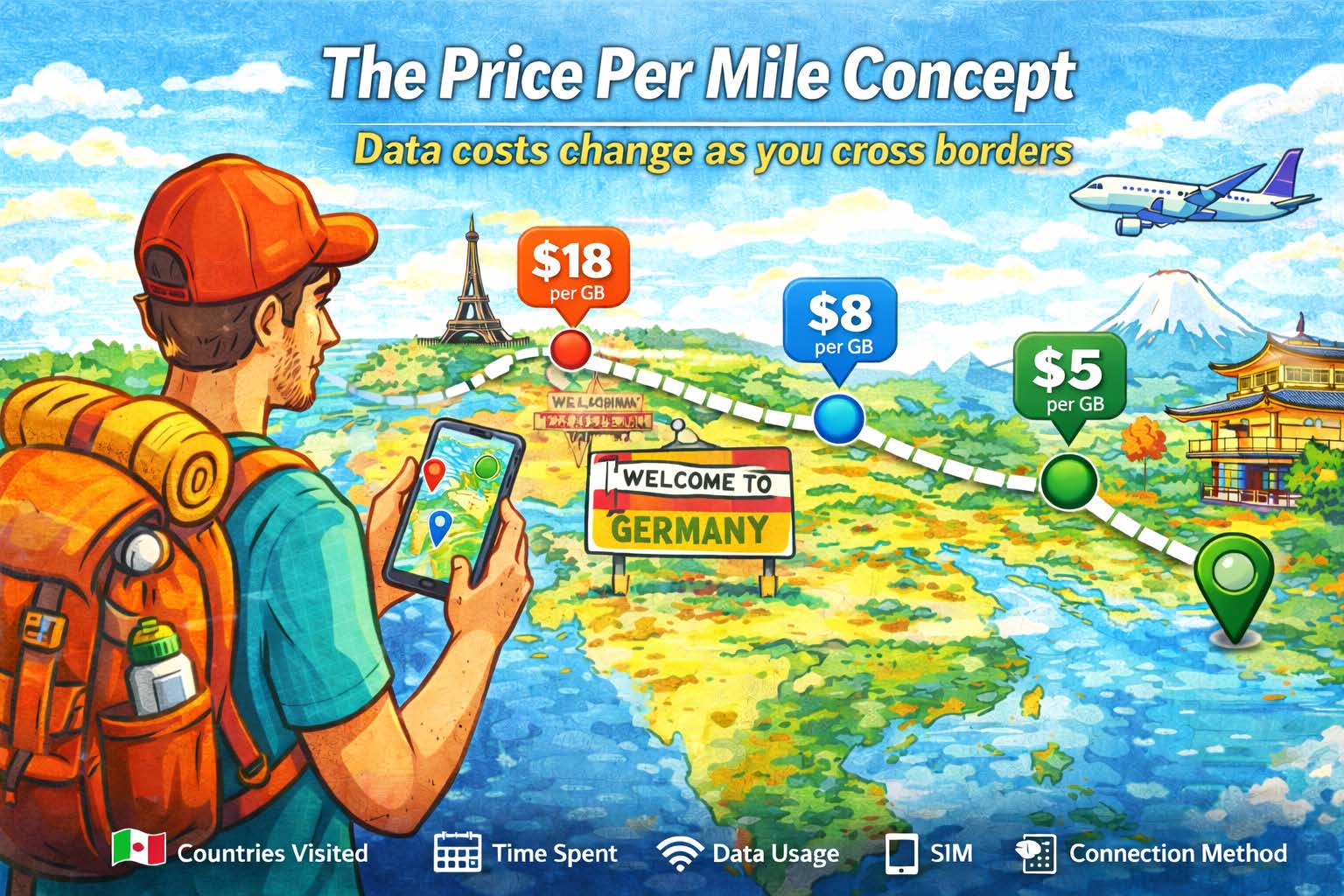
The Price Per Mile Concept

Cost per mile of international connectivity

Imagine plotting data prices on a map the same way you track gas stations during a road trip.

In major cities with strong competition, mobile data tends to be cheaper. Dense infrastructure, multiple carriers, and high demand push prices down.

In remote regions or smaller markets, costs can rise. Limited infrastructure means fewer options and higher wholesale rates.

When traveling internationally, your effective “price per mile” depends on:

  • How many countries you visit

  • How long you stay in each place

  • How much data you use

  • Which connection method you choose

A single-country trip might favor a local SIM. A multi-country route often leans toward eSIM. A quick business trip might justify roaming for speed.

There’s no one-size-fits-all answer. There’s only the right choice for your journey.


The Hidden Costs Beyond Price

Data pricing isn’t just about dollars per gigabyte. There are other factors that shape the true cost of staying connected.

Time

Searching for SIM shops, waiting in line, and setting up new plans takes time you could spend exploring or working.

Continuity

Switching SIM cards can interrupt access to your primary number, banking alerts, or two-factor authentication.

Coverage

Some plans work well in cities but struggle in rural areas. Multi-network access can make a noticeable difference.

Stress

Unexpected charges, slow speeds, and connection gaps can turn small issues into big headaches.

When you consider these factors together, the “cheapest” option isn’t always the most economical in the long run.


How Digital Nomads Think About Connectivity Costs

For remote workers, data isn’t a luxury. It’s infrastructure.

A freelancer uploading files, a developer joining video calls, or a content creator sharing media depends on reliable, steady connectivity. The goal isn’t just low cost. It’s predictable performance.

This is where the value equation shifts.

Instead of asking, “What’s the cheapest gigabyte?” many nomads ask:

  • Will this work everywhere I go?

  • Will I stay connected across borders?

  • Can I avoid constant setup and downtime?

For long-term travel, consistency often matters more than squeezing out the lowest possible price in each location.


The Visual Map of Global Data Value

If you could see global data prices drawn across a world map, it might look like a patchwork quilt.

Some regions would glow with affordable, fast connectivity. Others would show higher prices or limited coverage. And across it all, you’d see three overlapping layers:

  • Roaming, with wide reach but higher costs

  • Local SIMs, with low prices but limited range

  • Travel eSIMs, offering balance across distance

The best choice depends on how your path crosses that map.

A single destination favors simplicity.
A long stay favors local integration.
A multi-country adventure favors flexibility.


Making the Smart Choice for Your Trip

Before your next journey, think about your data plan the way you think about your route.

Ask yourself:

  • Am I staying in one country or moving frequently?

  • Do I need constant access for work or navigation?

  • How important is keeping my main number active?

  • Do I want the lowest possible cost, or the most consistent experience?

These answers will guide you toward the best option for your situation.


Staying Connected Without Surprises

In the end, the true cost of connectivity isn’t just measured in gigabytes. It’s measured in freedom.

The freedom to open your map without hesitation.
To book a ride without searching for Wi-Fi.
To send a message from a train crossing a border.

When you understand how roaming, local SIMs, and travel eSIMs compare, you can choose a path that fits your travel style and your budget.

Because every mile you travel shouldn’t feel like a meter running in the background.

It should feel like the world getting a little more connected, one signal bar at a time.

What is the Best Travel eSIM Card & Why?

Phone that includes eSIM.

We discussed eSIMs (embedded SIM cards) in a previous post. eSIMs aren’t all created equally, though. An “international eSIM card” is a bit of a misnomer. International / travel eSIMs are the of roaming SIMs as physical SIMs move into the past. The reason for the change is because device manufacturers save space on the device by replacing the physical SIM and it with eSIM technology. eSIMs are probably better called “SoftSIMs.” They are simply nothing more than a piece of software downloaded into devices enabled to understand this technology. What makes for the best travel eSIM then?

The world is becoming more and more data centric, so most eSIM providers only include data usage, They don’t bother to support voice or text. However, voice and text remain important for the international roaming SIM market. The growth of data centric applications like WhatsApp, Facetime, Telegram, Skype, etc. are changing the way providers deliver their services. You can communicate with friends and family, post messages and even place video calls with data only. This doesn’t work well for the international traveler, and is a major problem/flaw. It forces the international traveler to use another provider to place calls and send and receive SMS. This is because these roaming eSIMs don’t include a phone number. Without a phone number you can’t call your Uber driver, talk to your bank, call the restaurant that you are running late, etc.

This is where OneSimCard international eSIMs really stands out. Our international eSIMs support Data, Voice & Text messaging. Our SIMs include an EU based phone number and you can also choose alternate phone numbers (Personal Extra Numbers, or PENs). You can get in-country phone numbers in 70+ destinations with OneSimCard eSIMs.  You can set your alternate number as your caller ID so that your phone appears to be a local caller. What’s more is you can get a USA phone number that is a true mobile number. This USA mobile number allows you to receive 2FA verification messages required by banks, the IRS, and pretty much any other US company.

Usability is another important feature making an eSIM the best international eSIM.  eSIMs should be simple to install and have flexible plans. Flexibility is key as travel patterns. Meant for a single country, most eSIMs aren’t flexible because you can’t move between countries. OneSimCard eSIMs are designed to be used over and over for years, and in many different countries. Our plans are flexible; even in a single trip. We also offer 2 different eSIMs: our World eSIM for the greatest # of destinations, & our Asiania eSIM for use especially in Asia and Oceania.

The amount of support and applications available from the eSIM provider is the last factor for rating travel eSIM cards. OneSimCard is one of the only international eSIM providers with its own VOIP app (available in Google Play and Apple APP Store)for US and Canadian phone numbers to reduce the cost of Voice and Text services. OneSimCard also has eSIM apps in Apple App store and Google play. You can manage all aspects of your travel eSIM right in these apps. Multi-lingual customer service is also available by phone, email and online.  

You need to read the fine print and look at the reviews for eSIM service providers before you buy. There has been a rapid growth in this space, and COVID forced some closed. We have been in business for over 27 years, and have a 4.5 star rating with Shopper Approved with 2500+ reviews.

More information about our international roaming eSIM is available on our website: https://www.onesimcard.com/esim or simply scan this QR code. This page will help you further understand why the OneSimCard international eSIM for travel is the best option for your eSIM enabled phone when you are abroad. You can also reach out to us, and ask any questions that you may have. 

Wishing you safe travels!

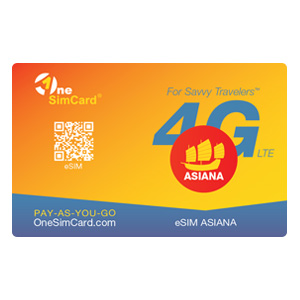
New Specialty “Asiana” eSIM Now Available

The Asiana eSIM is a specialty eSIM that is focused on 30+ Asia and Oceania countries, with other destinations included as well.

As of July 12, 2021 the list of destinations is:

Australia, Bahrain, Bangladesh, Cambodia, Canada, Chile, China, East Timor, Egypt, India, Indonesia, Iran, Japan, Kenya, Kuwait, Kyrgyzstan, Laos, Macau, Malaysia, Mexico, Moldova, Morocco, New Zealand, Philippines, Qatar, Russia, Saudi Arabia, Singapore, South Africa, South Korea, Taiwan, Tanzania, Thailand, Tunisia, UAE, USA, & Uzbekistan. Rates in many of these destinations will be significantly less than our current eSIM or other SIM cards.

This card also provides several inexpensive plans (1000mb, 3000mb & 5000mb) for these destinations: Australia, Cambodia, China, Egypt, India, Indonesia, Japan, Macau, Malaysia, New Zealand, Philippines, Saudi Arabia, Singapore, South Korea, Taiwan, Thailand, UAE, USA, Uzbekistan

This eSIM is a great supplement to our current eSIM offering, and can be used as a second eSIM on your device when traveling to the listed destinations to potentially save on Voice, Data and SMS charges.

Buy Asiana eSIM